Why Most First Sales Hires Fail Before They Ever Walk in the Door
The pattern is expensive, demoralizing, and it repeats itself often enough that it deserves a clearer explanation than most founders receive.
A founder builds a business to somewhere between one and five million dollars in revenue, largely by being very good at sales. They reach a point where the calendar cannot absorb any more selling time and the growth ceiling becomes obvious. They hire a salesperson. The salesperson struggles to build pipeline, does not close at the rate the founder expected, and is gone within twelve to eighteen months. The founder concludes that finding good salespeople is nearly impossible, tries again with someone different, and encounters the same result.
The problem in almost every case is not the salesperson.
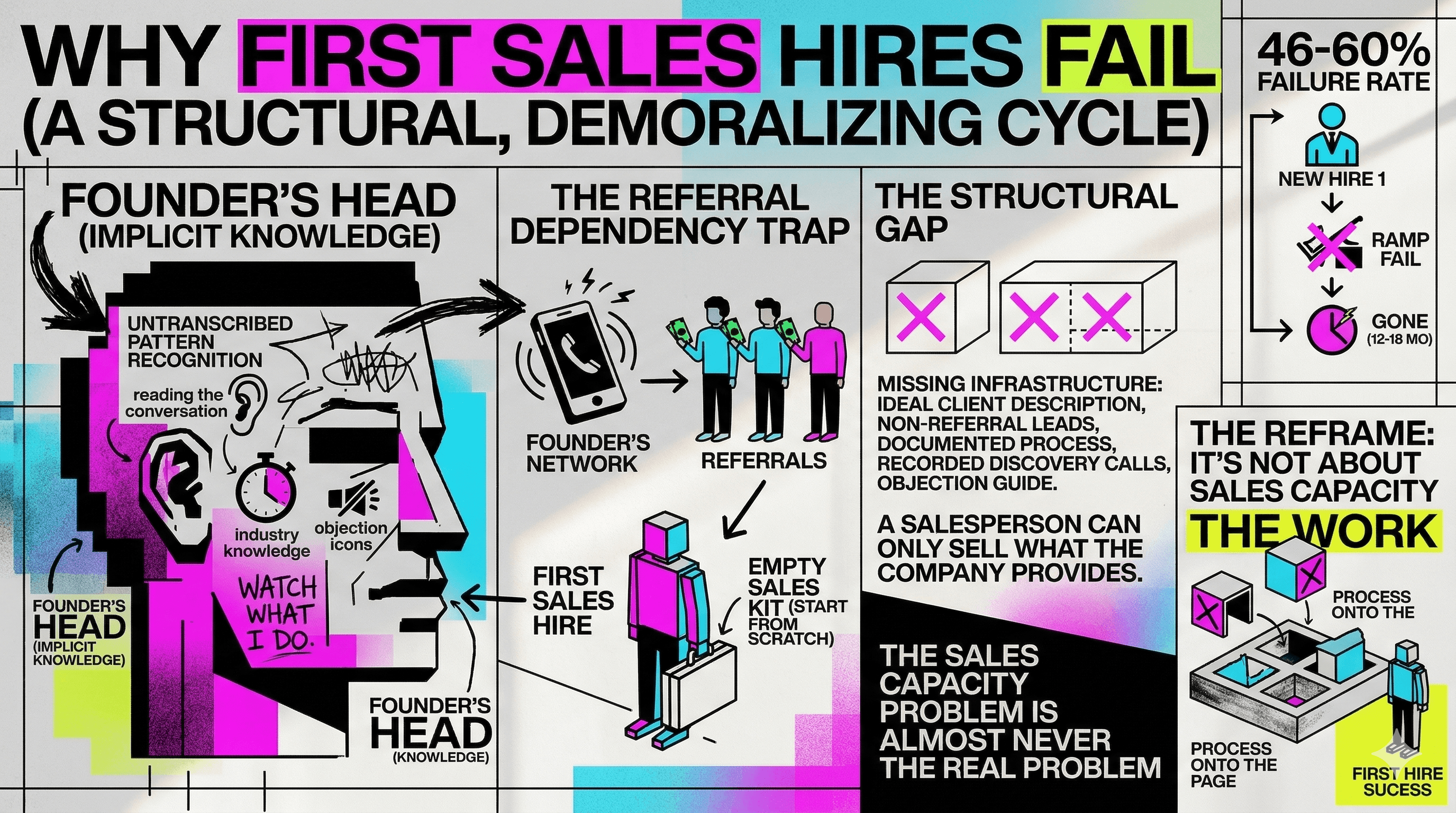
The data on first sales hires in professional service businesses is remarkably consistent. Depending on the source and segment, somewhere between 46 and 60 percent of first sales hires fail within their first year. At agencies and professional service firms specifically, research across more than a hundred companies found that 55 percent of first sales hires lasted less than twelve months, and only 9 percent hit or exceeded their revenue targets. These are not companies making careless hiring decisions. Many of them are thoughtful founders who interviewed carefully, paid competitive compensation, and gave the new hire real opportunities. The failure was structural, not personal.
The structural problem is this: most founders hire a salesperson before building the infrastructure that a salesperson needs to succeed.
The most common version of this problem is what I think of as the referral dependency trap. In the research, 82 percent of professional service firms report that referrals are their primary source of new business. Referrals are an excellent lead source. They convert at higher rates, they close faster, and they arrive with a baseline of trust that makes the selling conversation easier. But referrals are almost always a function of the founder's personal network and professional reputation, relationships built over years in a specific market. When a new salesperson arrives, they inherit none of that. The founder's phone keeps ringing with opportunities that naturally find their way back to the founder. The salesperson, left to build their own pipeline in a company with no documented outbound process and no lead generation channel beyond the founder's personal relationships, is starting from scratch. In zero documented cases did a first sales hire successfully build a lead generation channel from scratch without documented support and process guidance already in place.
The second version of the problem is harder to see, which is part of why it persists. Founders who have been selling their services for years have developed an enormously sophisticated understanding of their buyers. They know how to read a conversation. They know when a prospect is genuinely ready to move and when they are still exploring. They know how to navigate the specific objections that come up in their market, how to position their approach against alternatives, how to build trust quickly with the kinds of buyers they serve best. This knowledge was built over thousands of conversations, and most of it was never written down because there was no reason to write it down when the founder was handling every important sales conversation personally.
When a new salesperson arrives and the founder says "watch what I do," the new hire can observe the output of this expertise. They cannot observe the accumulated input that produces it. They see a polished, confident sales conversation. They do not see fifteen years of pattern recognition, relationship context, and industry knowledge that is operating beneath the surface of that conversation. They go to their own sales meetings, attempt to replicate the tone and approach they observed, and wonder why their results look so different.
The gap is not talent. The gap is that a salesperson can only sell what the company provides to them: the brand, the documented value proposition, the defined process. If none of those things have been built, the salesperson is working with a fraction of what they need.
The minimum viable infrastructure that needs to exist before a first sales hire has a realistic chance of success is not complicated, but it requires deliberate work to produce. It includes a written description of the ideal client specific enough to guide outreach, at least one lead source that produces consistent conversations outside of referrals, a documented sales process with defined stages and qualification criteria, recorded and annotated examples of good discovery conversations, and basic guidance on the objections the new hire will encounter most frequently. Companies that had resolved at least two of these gaps before hiring saw their new hires become productive in under sixty days. Companies that hired without any of this infrastructure watched ramp times stretch past six months, with failure rates that matched the industry averages.
The insight that most founders find uncomfortable to sit with is that the sales capacity problem is almost never the real problem. The problem is that what the founder has built is a selling capability that is personal to them, and the work of translating that into a process someone else can follow has not happened yet. That translation is what makes a first sales hire viable. Without it, you are not hiring a salesperson. You are hiring someone to discover, at significant cost and over the course of a year, everything that has not been built.
The good news is that the work itself is not as difficult as the consequences of skipping it. It takes weeks, not months. It requires sitting with the question of how your best clients actually came to hire you, what they needed to believe before they said yes, and what you did in those conversations that someone else could learn to do. That knowledge exists. It lives inside the founder's head, untranscribed. Getting it out of there and onto the page is the real prerequisite for a sales hire that succeeds. And it is the only one that no amount of good recruiting can substitute for.