What Your CRM Setup Is Trying to Tell You
When founders in the businesses I work with decide they are ready to implement a CRM, the conversation starts in roughly the same place every time. They want pipeline visibility. They want their team logging activity. They want to connect the inbox and see some reporting. These are reasonable goals and the technology is more than capable of delivering all of them.
About three weeks in, something shifts. The conversation stops being about the software and starts being about something the setup process uncovered.
They could not define their stages.
Not because they run disorganized businesses. These are experienced operators who have built real revenue, hired real teams, and earned the right to feel confident about what they have built. But when the moment came to configure the pipeline stages that everyone on their team would follow, they realized that their sales approach works specifically because they are the one executing it. Translating that into a defined process that could be captured in a system turned out to be a fundamentally different kind of work than they expected.
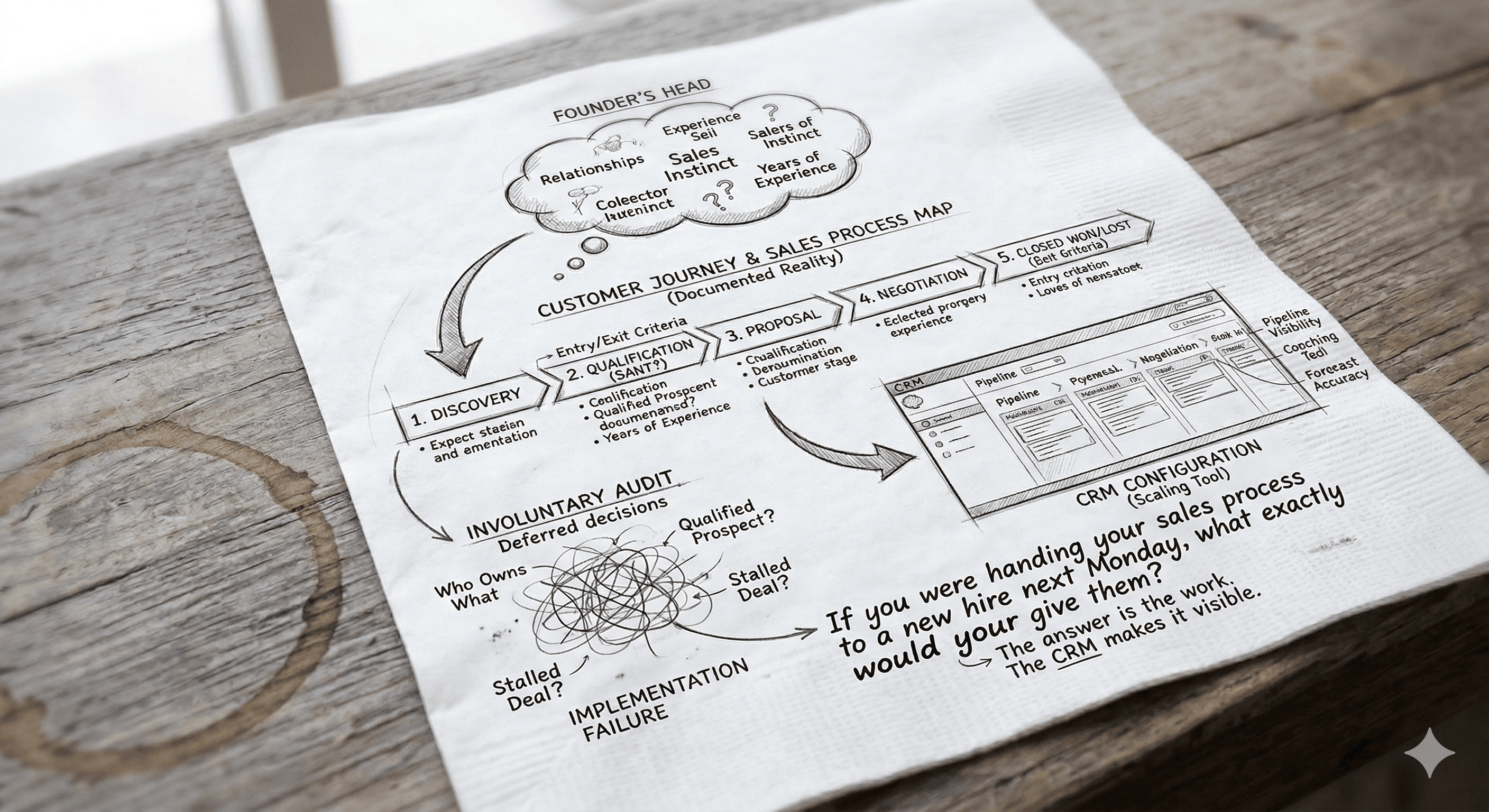
This is one of the most consistent patterns I see across the businesses I advise. Technology implementation does not just deploy a tool. It surfaces the degree to which a process exists as documented reality, as opposed to living in the founder's head.
The data on CRM projects reflects this at scale. More than half fail to achieve their intended objectives. The primary cause in the majority of cases is not the software, not the price, and not the complexity of the integration. It is low user adoption, driven by the fact that the system was configured to track a process that was never explicitly defined. You cannot ask a team to follow a process in a system when the process itself has never been written down. What gets built is a glorified contact list, and over time nobody uses it because it does not reflect how work actually happens.
There is a useful reframe here that changes how founders approach the entire technology conversation. A CRM is a scaling tool. Its job is to multiply what already exists. If what exists is a well-defined, repeatable sales process with clear stages and documented entry and exit criteria, then a CRM gives you visibility into that process, helps you coach your team against it, and makes forecasting substantially more accurate. If what exists is a founder who is very good at selling based on years of experience and relationship capital, then the CRM gives you a detailed record of that founder's activity that is difficult for anyone else to replicate.
Technology scales what you have. The question the implementation is asking is whether what you have is scalable at all.
Research from the Brooks Group found that 62 percent of high performing sales teams have their defined sales process integrated into their CRM, compared to 40 percent of teams that consistently underperform. The gap is not in the software. It is in whether the process the software is tracking was defined before the software was purchased.
The sequence that produces working implementations is straightforward, though it requires work that most companies skip. You start with the customer journey: how do your best clients actually buy, what triggers their decision to engage, what questions they have at each stage, and where they typically stall. From that map, you build a sales process that reflects how your customers buy rather than how you prefer to sell. Each stage in the pipeline corresponds to something that has shifted in the buyer's decision process, not in your proposal timeline. Then you identify what information needs to be captured at each stage to coach your team and forecast accurately. Only then do you configure the system.
When this sequence is followed, the CRM implementation is almost anticlimactic. The system is capturing a process that already exists in documented form. The adoption problem largely disappears because the team is logging activity in a system that reflects how they already work. The pipeline becomes a coaching tool rather than a reporting obligation.
When the sequence is reversed, which happens most of the time, the implementation becomes what I think of as an involuntary audit. Every decision that has been deferred — who owns what, what a qualified prospect looks like, what a stalled deal looks like — all of them surface at once. Founders discover that their sales motion is personal rather than systematic, and that the gap between those two things is more significant than expected.
None of this is a failure state. It is useful information, and the companies that take the audit seriously rather than treating it as an obstacle to push past are the ones I most respect. What the CRM setup process is telling you, when it surfaces these gaps, is what needs to be built before a sales team can operate without the founder in every conversation.
The companies that do this work seriously come out the other side with something more valuable than a configured CRM. They have a documented understanding of how their best clients buy, a defined process their team can follow, and the beginning of a coaching framework that gives everyone language for why deals move forward and why they stall. Those outputs travel. They feed hiring, onboarding, marketing, and the transition from sales to delivery in ways that no software configuration alone can produce.
The practical question that cuts to the center of this is simple, though the answer is usually more complicated than expected: if you were handing your sales process to a new hire next Monday, what exactly would you give them?
Whatever that answer surfaces is the work. The CRM makes it visible. Getting the work done before the technology is what makes the implementation succeed.